
Table of Contents
- What You'll Need Before You Start
- How to Measure Chest for Shirt Size
- How Should a T-shirt Fit?
- Shirt Size Chart for Men: Reading Measurements Correctly
- Slim Fit vs. Regular Fit: Choosing Your Preference
- Fabric-Specific Sizing Adjustments and Non-Standard Body Shapes
- Common Measurement Mistakes to Avoid
- Conclusion
- Frequently Asked Questions
Last Updated: September 11, 2026
What You'll Need Before You Start
Getting the right fit starts with the right tools. A flexible measuring tape, a well-fitting shirt you already own, and five minutes in front of a mirror are enough to nail down your measurements before buying online.
Here's what to gather:
- Flexible measuring tape (cloth or retractable, not a rigid metal tape)
- A fitted t-shirt or dress shirt you already like the fit of
- A mirror or a second person to help with hard-to-reach spots
- A pen and paper or your phone's notes app to record numbers
This guide walks through every measurement that actually matters, including the fabric and fit details most size charts leave out.
How to Measure Chest for Shirt Size
Wrap the measuring tape around the fullest part of your chest, keeping it level under your arms and parallel to the floor. This number is the foundation for every shirt size decision you'll make.
Stand relaxed with your arms at your sides and breathe normally. Pull the tape snug but not tight, and check in a mirror that it isn't twisted or riding up in the back.
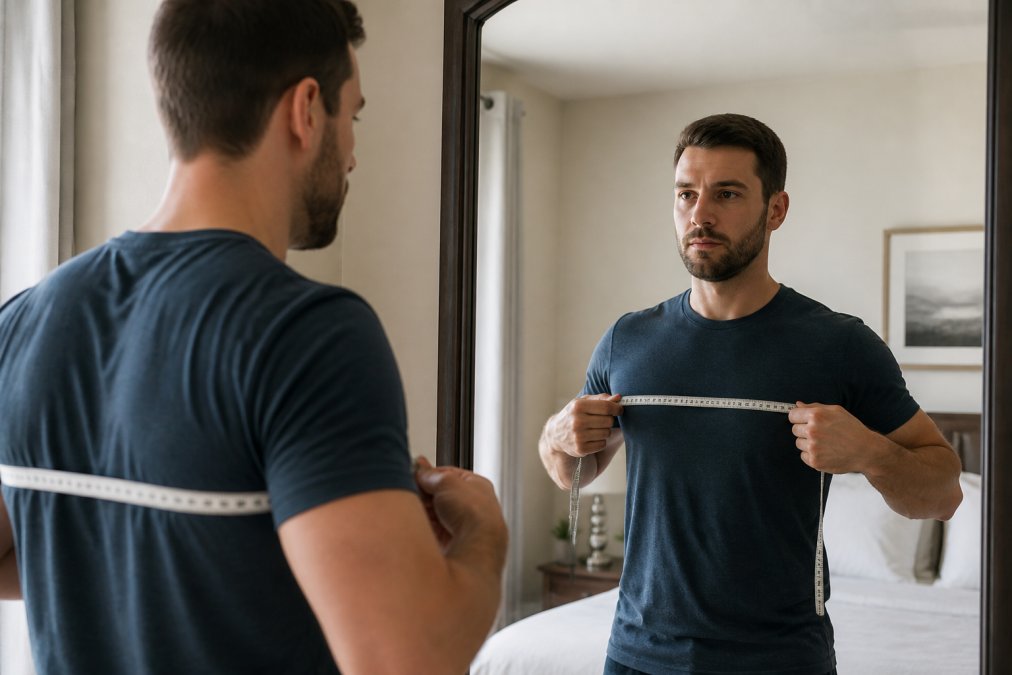
Record the number in inches and round to the nearest half inch. If you're between sizes, most brands recommend sizing up for a relaxed fit or down for a tailored fit.
Measuring Sleeve Length and Shoulder Width
Sleeve length runs from the center back of your neck, across the shoulder, and down to just past the wrist bone for long sleeves.
Shoulder width is measured seam to seam across the back. For a dress shirt, that seam should sit right at the edge of your shoulder, not hang past it.
Neck and Waist Measurements for Dress Shirts
Neck measurement decides your collar size. Wrap the tape around the base of your neck, just below the Adam's apple, and add half an inch for comfort.
Waist measurement matters most with tucked-in styles. Measure around your natural waistline, the narrowest point above your belly button, and compare it against the shirt's listed waist width, not your pants size.
How Should a T-shirt Fit?
A well-fitting t-shirt skims your torso without clinging or ballooning. The shoulder seams should land at the edge of your shoulders, the sleeve should end mid-bicep, and the hem should hit around mid-fly.
Check three points when you try one on:
- Shoulders: seams sit at the shoulder edge, not drooping past them
- Chest: fabric lies flat with a little room to move, no pulling at the buttons or armpits
- Length: hem falls between your waistband and hip bone for a standard fit
If the shirt pulls across your chest or rides up when you raise your arms, size up. If it billows at the waist, you likely need a slimmer cut rather than a smaller size.
Shirt Size Chart for Men: Reading Measurements Correctly
A shirt size chart for men usually lists body measurements, not garment measurements, and that distinction trips up more shoppers than any other part of the process. If you measure your chest at 40 inches and the chart says a medium fits a 38-40 inch chest, you are a medium. But if the chart lists garment measurements, that same medium might have a chest width of 44 inches when laid flat and doubled.
Body Measurements vs. Garment Measurements
Body measurements are taken around your actual body. Garment measurements are taken from the shirt itself, usually laid flat across the chest and doubled. A shirt with a 22-inch flat chest measurement has a 44-inch garment chest circumference, which does not mean it fits a 44-inch body. The difference, called ease, is the room built in for movement. A shirt with a 44-inch garment chest typically fits a 40-42 inch body comfortably.
Always check which type the brand uses. "Fits chest 38-40" is a body measurement; "chest width 22 inches" is a flat garment measurement you must double and subtract for ease.
| Measurement | How to Measure | Typical Range (S to XL) |
|---|---|---|
| Chest | Around fullest part, under arms | 34-46 inches |
| Neck | Around base of neck, plus 0.5 inch | 14-17 inches |
| Sleeve | Center back neck to wrist bone | 32-36 inches |
| Waist | Around natural waistline | 28-40 inches |
| Shoulder | Seam to seam across the back | 16-20 inches |
| Shirt Length | From high point shoulder to hem | 27-32 inches |
How to Use a Size Chart Step by Step
- Take your body measurements using the steps above.
- Find the brand's size chart on the product page and identify whether it lists body or garment measurements.
- Match your largest relevant measurement to the chart. If your chest is 41 inches and your waist is 34, and the chart puts a large at 40-42 chest and 33-35 waist, you are a large.
- If you fall between two sizes, check the fabric content. Cotton that will shrink suggests sizing up; stretch fabric suggests staying true to size.
- If the brand offers a fit guide with model measurements, compare your numbers to the model's to see how the shirt drapes.
International Size Conversion and Brand Variations
Sizing standards differ across regions, and ignoring that difference is one of the most common reasons for returns. European sizing runs smaller than standard sizing, often by a full size or more, so a European large frequently matches a medium in most American brands. Asian sizing can run two sizes smaller, so an Asian XL may fit like an American medium.
Keep a conversion note on your phone with your chest, neck, and sleeve numbers in both inches and centimeters. To convert inches to centimeters, multiply by 2.54; to go the other way, divide by 2.54.
A practical conversion reference for tops:
- American medium typically equals a European large and an Asian extra-large.
- American large typically equals a European extra-large and an Asian double-extra-large.
- American small typically equals a European medium and an Asian large.
These are general patterns, not universal rules. Always check the specific brand's chart, because vanity sizing and regional cuts vary. When in doubt, compare your body measurements to the chart's numbers rather than the letter on the tag.
Slim Fit vs. Regular Fit: Choosing Your Preference
Slim fit tapers through the waist and chest for a closer silhouette, while regular fit leaves more room through the torso and sleeves. Neither is "better," they simply suit different body proportions and styling goals.
- Slim fit works well for leaner builds or anyone who wants a tailored fit without tailoring
- Regular fit suits broader shoulders, thicker midsections, or anyone who prefers a relaxed fit
- Relaxed fit adds extra room through the chest and hem, best for layering or casual wear
If you're between builds, a regular fit with a trip to the tailor beats a slim fit that pulls at the seams. Try both cuts in the same size before committing to a bulk order.
Fabric-Specific Sizing Adjustments and Non-Standard Body Shapes
Fabric changes fit more than most shoppers expect. Cotton shrinks, stretch blends relax, and heavyweight knits hold their shape differently than thin jersey. Understanding these mechanics lets you buy the right size the first time.
How Fiber Content Affects Fit After Washing
- 100% cotton: Woven cotton shirts commonly shrink about 2-3% in length and 1-2% in width after the first hot wash and dry. If you are between sizes and plan to machine dry, size up; if you wash cold and hang dry, shrinkage drops to under 1%.
- Cotton-poly blends (typically 60/40 or 50/50): The synthetic fiber resists shrinkage, so a blend usually loses less than 1% overall and holds its labeled size well, the safest choice for online ordering.
- Stretch fabrics (cotton with 2-5% elastane or spandex): These relax with wear and return partially after washing. Buy true to your measurement, not tight.
- Heavyweight knits (7 oz and up): These keep their shape but offer less give, so measure carefully and avoid sizing down.
- Linen: Minimal shrinkage if washed cold, but it wrinkles and drapes loosely, appearing a half size larger than the same cut in cotton. Consider sizing down for a closer fit.
Non-Standard Body Shapes: Specific Adjustments
Standard size charts assume average proportions. If your build falls outside that average, adjust your measuring strategy rather than forcing yourself into a size that fits one area and fails another.
Athletic or muscular builds (broad chest, narrow waist): Your chest may put you in a large while your waist suggests a medium. Buy for the chest and have the waist taken in, a tailor can remove 1-2 inches from the sides. Do not buy for the waist and hope the chest stretches.
Tall and slim builds (long torso, narrow frame): Standard shirts often run short in the body and long in the sleeve. Check the listed shirt length, not just the sleeve, and look for brands offering tall sizes, which add 1-2 inches to the body. If tall sizes are unavailable, a slim fit in your chest size usually drapes better than a regular fit that billows.
Plus-size builds (fuller midsection, broader waist): Measure your waist at its fullest point, not the narrowest, and compare that number to the shirt's listed waist width. Sizing up for the waist often leaves the shoulders and sleeves too large, so look for brands with extended sizing that adjusts multiple points, or choose a relaxed fit and have the sleeves shortened.
Short and broad builds: Sleeve length is often the problem. A shirt that fits your chest may have sleeves that extend past your wrist. Buying for the chest and having the sleeves shortened is usually cheaper and easier than finding a shirt that fits both off the rack.
A Quick Fabric-and-Body Checklist Before You Buy
- Check the fiber content on the label or product page.
- If cotton and you plan to machine dry, add a half size of margin.
- If stretch, buy true to measurement, not tight.
- If your chest and waist span two sizes, buy the larger and plan a tailor visit.
- If you are tall or short, check body length and sleeve length separately from chest size.
Common Measurement Mistakes to Avoid
The biggest mistake is measuring over bulky clothing or holding the tape at an angle. Both inflate your numbers and push you into the wrong size. Other frequent slip-ups:
- Measuring the neck too tight, then struggling to button the collar
- Using pants waist size instead of measuring the natural waistline
- Trusting a single brand's chart without comparing to your actual body measurements
- Skipping the sleeve measurement and guessing based on height alone
A common mistake is ordering based on the size you wore five years ago. Bodies change, and so do brand size charts, so remeasure before every major purchase.
Conclusion
Getting the fit right comes down to five numbers and a willingness to remeasure instead of guess. Chest, neck, sleeve, waist, and shoulder width tell you almost everything you need to choose the right shirt size, whether you're shopping for a dress shirt, a t-shirt, or a hoodie.
At Bargainoutlet.store, we build our patriotic tees and hoodies with sizing that matches standard American measurements, backed by our 30-day satisfaction guarantee and free shipping on orders over $50. Every piece is veteran-owned and made in the USA, so you can wear your values without worrying whether the fit will hold up.
Shop now at Bargainoutlet.store and find gear that fits right the first time.
Frequently Asked Questions
Is it better to size up or down in shirts?
Size up if you are between sizes or prefer a relaxed fit, especially for cotton shirts that may shrink slightly after washing. Size down only if you want a tailored fit and the fabric has stretch. For graphic tees, sizing up prevents the print from stretching across the chest. Always check the brand's shirt size chart for men, as measurements vary by manufacturer.
How do I determine my t-shirt size?
Measure your chest circumference at the fullest part, your waist at the narrowest point, and your shoulder width from seam to seam. Compare these numbers to the brand's size chart. If your chest measures 40 inches, you likely wear a medium in most standard sizing. For accurate fit, measure a t-shirt you already own and like, then match those garment measurements to the chart.
Does shirt sizing vary between brands?
Yes, sizing varies significantly between brands. A medium from one retailer may fit like a large from another. Fast-fashion brands often run smaller, while workwear brands tend to run larger. Always check the specific size chart for each brand. If you are buying patriotic apparel or graphic tees, look for brands that provide detailed garment measurements like chest width, shirt length, and sleeve length.
How should a high-quality graphic tee fit on the shoulders?
The shoulder seam should sit at the edge of your shoulder bone, not hang past it or pull inward. If the seam droops, the shirt is too big. If it pinches or restricts arm movement, it is too small. A proper shoulder fit ensures the graphic sits correctly on your chest and the armhole does not gap. For a tailored fit, the seam should align exactly with your natural shoulder edge.