
Table of Contents
- Why Fabric Weight and Material Composition Matter Most
- How to Check Clothing Quality: Stitching, Seams, and Construction
- Identifying Authentic Graphic Prints and Print Longevity
- Patriotic Apparel Made in America: How to Verify Claims
- Comfort, Fit Consistency, and Wash-and-Wear Performance
- Common Mistakes When Buying Patriotic Apparel
- Environmental Impact and Ethical Manufacturing Considerations
- Conclusion
- Frequently Asked Questions
Last Updated: September 13, 2026
Why Fabric Weight and Material Composition Matter Most
Judge patriotic apparel by two numbers before the design: fabric weight and fiber content. A heavier, denser knit holds its shape, resists shrinkage, and keeps a graphic readable far longer than thin promotional blanks.
A bold flag print on a flimsy shirt is a costume; on a substantial cotton tee it's a garment you'll reach for. Construction, not artwork, separates a shirt that lasts three washes from one that lasts three years.
Cotton vs. Cotton-Polyester Blends
Cotton breathes well, feels soft, and takes screen printing cleanly, but shrinks and wrinkles. Cotton-polyester blends resist shrinkage and fading better, though they feel less breathable.
Understanding GSM (Grams per Square Meter)
GSM measures fabric weight. A lightweight tee runs 140-160 GSM, a substantial everyday shirt 180-200 GSM, and a heavy hoodie can exceed 300 GSM. Higher GSM means better opacity, durability, and drape, but a warmer garment.
- Under 150 GSM: thin, prone to transparency
- 150-180 GSM: standard retail tee weight
- 180-220 GSM: premium everyday weight
- 300+ GSM: heavy fleece and hoodie territory
How to Check Clothing Quality: Stitching, Seams, and Construction
Learning how to check clothing quality comes down to three under-a-minute tests: inspect the stitching, flex the seams, and examine the hems. Dense, even stitching and reinforced seams signal a garment built to last.
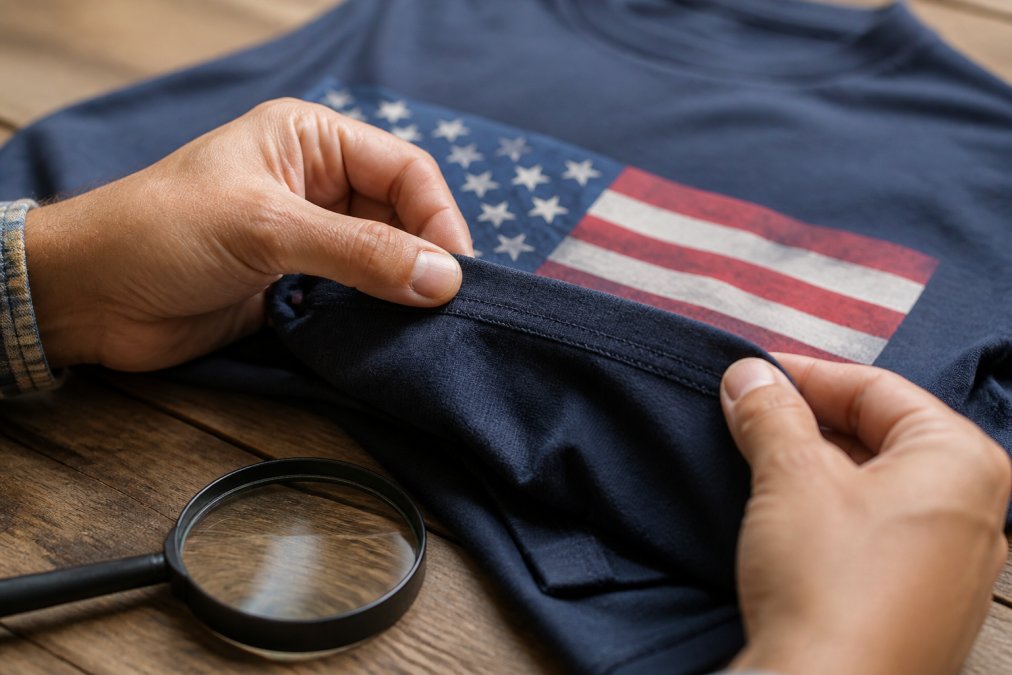
Stitch Density and Seam Integrity
Stitch density is how many stitches per inch (SPI) a seam contains. Quality garments run 10-12 SPI on main seams; sparse stitching, loose threads, or skipped stitches are red flags.
Hem Quality and Garment Construction
Check the bottom and sleeve hems for even width and a clean double-stitched finish. A wavy or twisted hem means the fabric wasn't allowed to relax before cutting, a shortcut that shows up after the first wash. A ribbed collar with proper recovery won't sag.
Identifying Authentic Graphic Prints and Print Longevity
Print longevity depends almost entirely on the decoration method. Screen printing, DTG (direct-to-garment) printing, and heat transfer each age differently, and knowing which one you're buying tells you how the graphic will hold up.
Screen Printing vs. DTG vs. Heat Transfer
Screen printing pushes thick ink through a mesh screen, producing a durable, opaque graphic that outlasts most methods on cotton. DTG printing sprays water-based ink onto fabric, great for detailed full-color images but prone to fading on dark shirts. Heat transfer applies a printed film with heat and pressure; affordable but prone to edge peeling.
| Method | Durability | Best For | Watch For |
|---|---|---|---|
| Screen printing | High | Bold graphics, cotton | Thick ink feel |
| DTG printing | Moderate | Detailed, full-color art | Fading on dark fabric |
| Heat transfer | Lower | Low-cost runs | Edge peeling |
Signs of Print Cracking and Fading
Inspect the graphic before you buy or wash. Cracking shows as fine white lines through the ink. Fading appears as a washed-out, patchy print, common with heat transfer and lower-quality DTG. A properly cured screen print stays flexible and saturated.
Patriotic Apparel Made in America: How to Verify Claims
Patriotic apparel made in America carries real weight for many buyers, but the label is where claims get murky. The FTC's Made in USA standard requires that "Made in USA" claims be backed by evidence that the product is "all or virtually all" made domestically. A shirt assembled here from imported fabric does not qualify.
Decoding Garment Labels and FTC Requirements
Read the label like a skeptic: country of origin, fiber content percentages, care instructions. A brand claiming domestic manufacturing should state where the fabric was knit and where the garment was cut and sewn. Vague "designed in America" phrasing is marketing, not a manufacturing claim.
Comfort, Fit Consistency, and Wash-and-Wear Performance
Fit consistency separates a brand you reorder from one you gamble on. A well-made shirt keeps its listed size across colorways and production runs, and holds that fit after washing.
Decoding the Care Label Like a Skeptic
The care label is a legal document, not a suggestion. Under the FTC's Care Labeling Rule, manufacturers must state at least one safe cleaning method. That single instruction tells you a lot. If a shirt says "machine wash cold, tumble dry low," the maker expects the fabric to survive normal wear. If it says "hand wash, line dry," the garment is fragile or the maker is protecting against shrinkage they didn't control.
Look for these specific phrases:
- Pre-shrunk or shrinkage-controlled: Indicates the fabric was treated to limit movement. Most practitioners find pre-shrunk cotton moves less than 2-3% after the first wash, while untreated cotton can shrink noticeably.
- Cotton/polyester blend percentages: A 50/50 blend resists shrinkage better than 100% cotton but may feel less breathable. A 60/40 cotton-heavy blend is a common middle ground for everyday tees.
- "Wash inside out": A signal that the print is the most delicate part of the garment, not the fabric.
Home Fabric Testing: The Stretch Test and Burn Test
You can run two simple tests at home to verify fiber content and quality without a lab.
The stretch test works for knit shirts. Grip the fabric near the side seam and pull gently. Quality cotton stretches and snaps back with little distortion; a high-polyester blend stretches easily but recovers slowly, leaving a slight bag. Stiff fabric that doesn't move is likely a tight, low-breathability weave.
The burn test is the most reliable home method for fiber content, but only on a loose thread or snippet from an inside hem, never the visible garment, in a fire-safe area. What the ash and smell tell you:
- 100% cotton: Burns quickly with a yellow flame, smells like burning paper, leaves soft gray ash.
- Polyester: Melts and shrinks away from the flame, smells sweet and chemical, leaves a hard black bead.
- Cotton-poly blend: A mix of behaviors, often a black bead with some soft ash, and a chemical-paper smell.
If the burn test contradicts the label, you have a strong case for a return or a chargeback, and you've learned the brand's labeling isn't trustworthy.
Fit Consistency Across Colorways
Darker dyes can slightly change the hand of the fabric, making a black shirt feel tighter than the same size in white. When ordering online, check reviews for "runs small" or "inconsistent sizing" across colors. A brand publishing a size chart with garment measurements, not just body measurements, is more likely to deliver consistent fit.
Wash-and-Wear Performance: What to Expect
Pre-shrunk cotton typically moves less than 2-3% after the first wash; untreated cotton can shrink 5% or more, enough to turn a large into a medium. Synthetic blends resist shrinkage but can pill over time, especially under the arms.
Breathability matters too. Natural fibers and open knits let heat escape, which is why a 100% cotton tee often beats a heavy blend in warm weather. But a lightweight cotton tee (under 150 GSM) may show every contour, so weigh airflow against opacity.
To maximize wash-and-wear life:
- Wash cold, inside out, with like colors.
- Tumble dry low or hang dry. High heat is the enemy of both cotton and prints.
- Avoid fabric softener, which can coat fibers and reduce breathability.
- If the shirt has a screen print, don't iron directly over the graphic.
A shirt that survives 20 washes without fading, cracking, or shrinking is a shirt worth reordering. That's the standard you should hold every patriotic apparel purchase to.
Common Mistakes When Buying Patriotic Apparel
The most common mistake is buying on design alone. A striking graphic on a 140 GSM blank with single-stitched hems is a shirt you'll replace within a season.
Other frequent errors:
- Trusting "military-grade" or "tactical apparel" language without checking fabric specs
- Assuming a higher price guarantees better construction
- Skipping the label and missing fiber content entirely
- Ignoring wash instructions and shrinking a good shirt into a bad one
Environmental Impact and Ethical Manufacturing Considerations
Patriotic fast fashion carries a hidden cost that most buyers never see. Cheap, short-lived garments get discarded quickly, and synthetic fibers shed microplastics with every wash. The EPA's materials and waste data tracks how much textile waste ends up in landfills each year, and the trend is not encouraging. But the trade-off between mass-produced patriotic gear and ethical, small-batch manufacturing is more nuanced than "buy less."
The Real Cost of a $10 Flag Tee
A $10 patriotic t-shirt is cheap for a reason: low-grade cotton or a high-polyester blend, thin fabric (often under 150 GSM), and single-stitched seams. It may survive a few washes before it pills, fades, or shrinks, then becomes waste. The impact isn't just landfill space; it's the water, energy, and chemicals used to produce a garment designed to fail.
Polyester also sheds microplastics during washing, particles too small for wastewater treatment plants to catch. A single wash can release hundreds of thousands of microfibers. That's not a reason to avoid all synthetics, but a reason to avoid cheap ones that wear out fast and shed more over a short life.
Small-Batch vs. Mass Production: The Trade-Offs
Small-batch manufacturing isn't automatically sustainable, but it often aligns with better practices:
| Factor | Mass-Produced Patriotic Gear | Small-Batch Ethical Manufacturing |
|---|---|---|
| Fabric quality | Often thin, high-poly blends | Typically heavier cotton or quality blends |
| Labor transparency | Rarely disclosed | Often published, sometimes certified |
| Durability | 10-20 washes before visible wear | 50+ washes with proper care |
| Environmental cost per wear | High, due to short lifespan | Lower, due to longer lifespan |
| Price | Low upfront | Higher upfront, lower cost per wear |
The key metric is cost per wear, not sticker price. A $30 shirt that lasts three years costs less per wear than a $10 shirt that lasts three months. Pay more now for a garment that respects your wallet and the environment over time.
How to Spot Ethical Manufacturing Claims
Brands that publish where and how their apparel is made tend to build garments worth keeping. Look for:
- Supply chain transparency: A brand that names its fabric mill and cut-and-sew facility is more accountable than one that says "imported."
- Worker treatment statements: Fair wages and safe conditions are baseline ethical requirements, not marketing extras.
- Certifications: While not required, certifications like OEKO-TEX Standard 100 indicate the fabric has been tested for harmful substances. This is a public standard, not an endorsement of any specific brand.
- Repair or take-back programs: Some brands offer to repair or recycle worn garments, which extends product life and reduces waste.
The Patriotism Angle
What does it mean to honor service and country through what you wear? If the answer includes supporting domestic workers, reducing waste, and building something that lasts, then quality and ethics are inseparable. A shirt that falls apart after a month doesn't honor anyone; one that holds up for years, made with respect for people and resources, does.
At Bargainoutlet.store, we built our patriotic apparel line for exactly this standard. Our veteran-owned operation offers graphic t-shirts, hoodies, and active wear for those who want quality without the high price tag, backed by a 30-day satisfaction guarantee and free shipping on orders over $50. If you want gear that honors the service and holds up wash after wash, browse the collection and shop now.
Conclusion
Judging quality takes a minute of hands-on inspection, not a leap of faith. Check the GSM, read the fiber blend, pull the seams, and verify any made-in-America claim against the label.
At Bargainoutlet.store, we built our patriotic apparel line for exactly this standard. Our veteran-owned operation offers graphic t-shirts, hoodies, and active wear for those who want quality without the high price tag, backed by a 30-day satisfaction guarantee and free shipping on orders over $50. If you want gear that honors the service and holds up wash after wash, browse the collection and shop now.
Frequently Asked Questions
What materials are best for long-lasting patriotic apparel?
Cotton-polyester blends offer a good balance of durability and comfort for patriotic apparel. Higher GSM (grams per square meter) indicates denser, more durable fabric. Check labels for fabric composition percentages.
How do I verify if patriotic apparel is made in the USA?
Check the garment label for 'Made in USA' claims, which the Federal Trade Commission regulates. A qualified claim like 'Assembled in USA' means significant parts are imported. Look for the FTC's required country-of-origin disclosure. Brands committed to domestic manufacturing often list their production facilities on their websites. You can also request supply chain transparency information directly from the company. Authentic American-made patriotic apparel typically includes detailed sourcing information and may cost more due to domestic labor standards.
What are the signs of poor-quality patriotic clothing?
Warning signs include loose or uneven stitching, thin fabric that feels flimsy, graphics that crack or peel after one wash, and labels that lack care instructions or country-of-origin information. Poorly constructed garments often have seams that pucker or unravel. If the print feels like a plastic layer sitting on top of the fabric, it may be a low-quality heat transfer. Check for loose threads at stress points like shoulders and armholes. Fabric that feels stiff or has an uneven weave typically indicates lower quality materials.
Why does fabric weight matter in graphic tees?
Fabric weight determines how a shirt drapes, how long it lasts, and how well it holds its shape. For patriotic graphic tees, a quality cotton or cotton-polyester blend resists print cracking and maintains colorfastness through repeated washing.